
How Key Signatures Are Determined in Keysignary
Today, there are many ways to determine the key of a song. Some rely on AI and automatic detection, others depend on community input, and a smaller number are analyzed directly by musicians.
Keysignary exists to clearly explain these differences, so users understand what they are getting and where the limitations are.
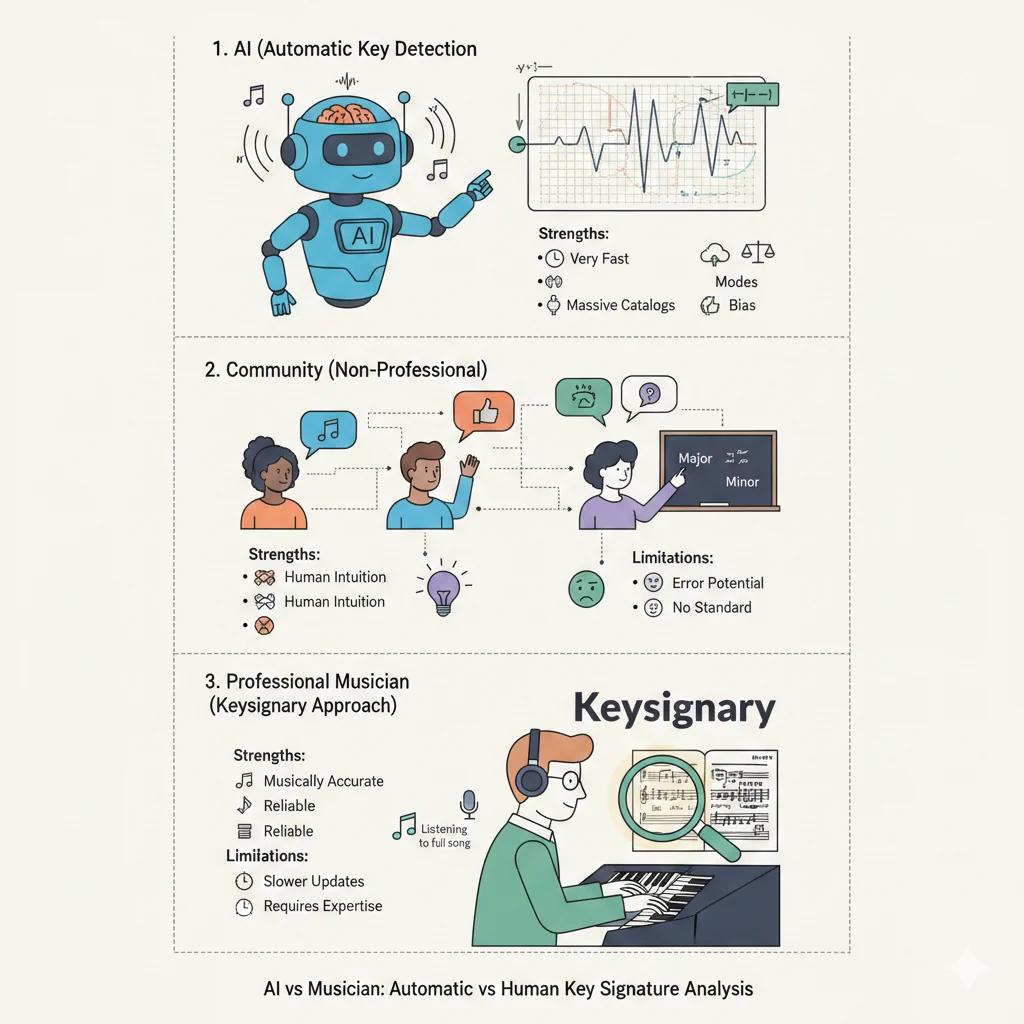
1. AI (Automatic Key Detection)
AI determines a song’s key by analyzing audio mathematically. It measures pitch frequency, note distribution, and tonal probability to guess the most likely key.
This approach is extremely fast and scalable, making it suitable for processing millions of songs. However, AI does not truly “understand” music in a musical sense.
Strengths:
- Very fast
- Can process massive catalogs
- Useful as a quick estimation tool
Limitations:
- Difficulty identifying modes (Dorian, Mixolydian, etc.)
- Easily misled by intros, loops, or repetitive vamps
- Strong bias toward nearby major or minor keys
- No awareness of harmonic function or musical resolution
2. Community (Non-Professional)
Community-based databases rely on user contributions. Anyone can submit a key based on personal listening or assumptions.
This method is human, but not always musically informed.
Strengths:
- More flexible than pure AI
- Human intuition is involved
- Can offer subjective insights
Limitations:
- Most contributors only recognize major and minor
- Modes are often misidentified
- No consistent analytical standard
- High error potential, especially with modal, progressive, or non-pop songs
3. Professional Musician (Keysignary Approach)
A musician analyzes a song as a complete musical structure, not just a collection of notes.
The process includes:
- Listening to the full song
- Identifying the tonal center
- Observing harmonic function and resolution
- Understanding genre and stylistic context
- Recognizing patterns algorithms typically miss
At Keysignary, every entry is analyzed by musicians and professional transcribers, not AI and not open voting.
Strengths:
- Musically accurate
- Clear distinction between key, mode, and tonal ambiguity
- Highly relevant for performers and learners
- Reliable for complex and non-mainstream music
Limitations:
- Cannot scale to millions of songs instantly
- Updates are slower than AI-based systems
- Requires expertise and time
Side-by-Side Comparison
| Aspect | AI | Community (Non-Pro) | Professional Musician |
|---|---|---|---|
| Method | Statistical audio analysis | Personal listening & assumptions | Full musical analysis |
| Mode Awareness | Low | Very limited | High |
| Major / Minor Bias | Very high | High | Low |
| Tonal Center | Estimated | Subjective | Functional & contextual |
| Accuracy on Complex Songs | Low | Low–medium | High |
| Number of Songs | Extremely large | Large | Limited |
| Update Speed | Very fast | Inconsistent | Slower |
| Performer-Friendly | Limited | Unreliable | Highly reliable |
| Learner-Friendly | Often unclear | Potentially confusing | Educational & clear |
Why Keysignary Chooses Musician Analysis
Keysignary does not aim to be the fastest or the largest database.
It aims to be the most musically reliable.
Every key signature in Keysignary is:
- Analyzed by a musician
- Based on the original recording (often from YouTube videos)
- Not transposed or simplified
- Presented with tonal and modal context
This approach helps:
- Performers who need to know where a song truly “starts”
- Learners who want to understand musical function, not just a key label
AI can guess.
Communities can assume.
Musicians analyze.
That is the foundation of Keysignary.