
Keysignary was created from a real frustration shared by many musicians and music students.
Over the years, I noticed how widely automatic key detection tools are used. In theory, many of these tools are correct. However, in real musical practice, they often create confusion, especially for learners who are still building their musical intuition.
A clear example is “Zombie” by The Cranberries.
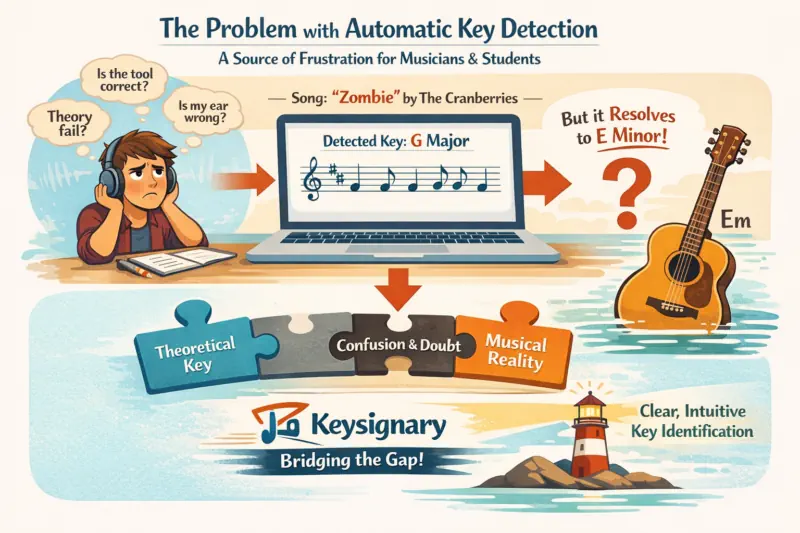
Most automatic detectors label the song as G Major because the notes match that key signature. Yet musically, the song clearly resolves to E minor. For students, this creates unnecessary doubt. Is the tool correct? Is their ear wrong? Or is music theory failing to explain what they hear?
That gap between theoretical detection and musical reality is the reason Keysignary exists.
More Than Just Major and Minor
Music cannot always be reduced to major or minor labels.
Keysignary is not a simple key list. It is a key signature database that also documents:
- Modes such as Dorian, Mixolydian, and others
- Clear tonal centers
- Context based harmonic analysis
By including these elements, we remove ambiguity. A song is not labeled only by what fits on paper, but by how it actually functions musically. This makes the information clearer, more practical, and easier to understand.
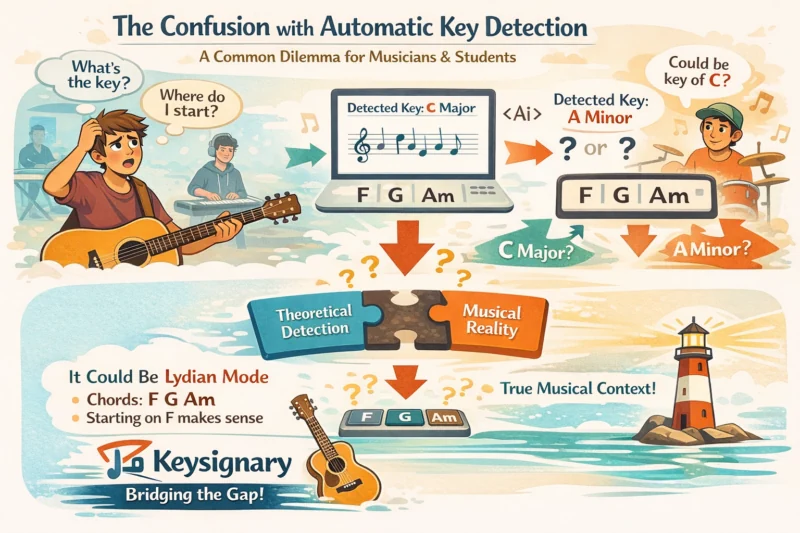
Imagine a song written in the F Lydian mode, built on a progression of F – G – Am. Even though the tonal center feels like F, an AI detection tool might incorrectly label the key as C Major or A Minor simply because they share the same key signature. This creates a disconnect for musicians; while the software sees the notes, the artist feels the “gravity” of the F major chord. When fellow musicians ask, “What key are we in, and where does it resolve?”, the standard answers feel technically correct but musically wrong. This is where Keysignary bridges the gap, moving beyond raw note detection to provide the true musical context, ensuring that the unique character of the Lydian mode is recognized and respected.
Explaining music theory in a way that makes sense.
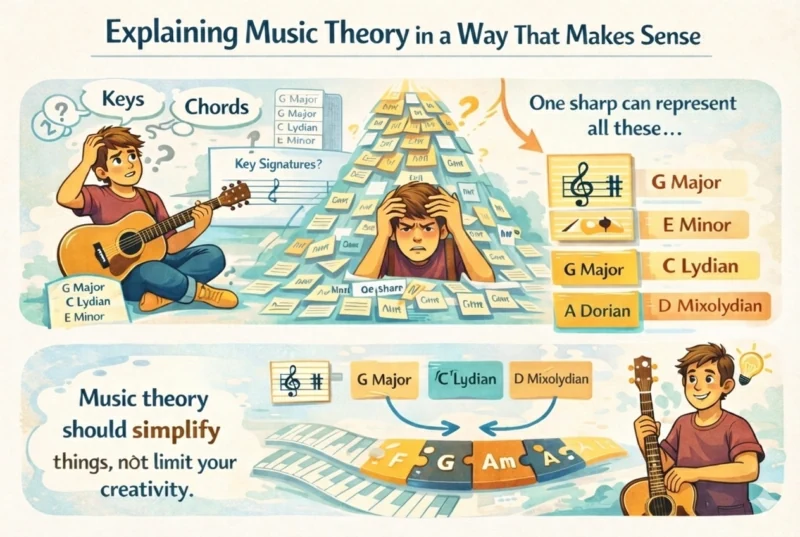
Self-taught musicians, especially guitarists, are generally unfamiliar with the concept of ‘key signatures,’ though they are very familiar with ‘keys’ and ‘chords.’ Key signatures can be difficult to explain, particularly if the musician does not read sheet music or has never studied formal notation.
Learning music by memorizing every mode for every key consumes too much mental energy. In reality, a single key signature can represent multiple modes and keys; for example, ‘one sharp’ can represent G Major, E Minor, C Lydian, and more.
Music theory should be a tool that simplifies things for you, not something that limits your creativity.”
Human Analysis, Not Machine Detection
What truly sets Keysignary apart is how the data is created.
The information is not generated by automatic detection tools.
It is not crowdsourced or based on unverified community submissions.
Every entry is analyzed and validated by a musician.
Each key decision is made by listening carefully, observing harmonic movement, understanding resolution, and considering musical context. This approach ensures accuracy that reflects real music making, not just theoretical calculation.
Musical Authority
Keysignary is founded and curated by Amri MF, a professional music transcriber and analyst.
Amri has transcribed more than 500 songs across various genres, with a strong focus on accuracy, harmonic clarity, and musical feel. His work has received over 300 five star ratings from clients on platforms such as PaidTabs and Upwork, reflecting consistent trust from musicians around the world.
This extensive transcription experience shapes how Keysignary approaches key analysis. Every key signature, mode, and tonal center is evaluated through real musical application, not abstract theory alone. Decisions are based on how music resolves, how it is played, and how musicians actually hear it.
Keysignary exists as an extension of that professional practice. The goal is to provide reliable, musician validated key information that students, educators, and working musicians can trust without confusion.
Start Every Song with the Right Key
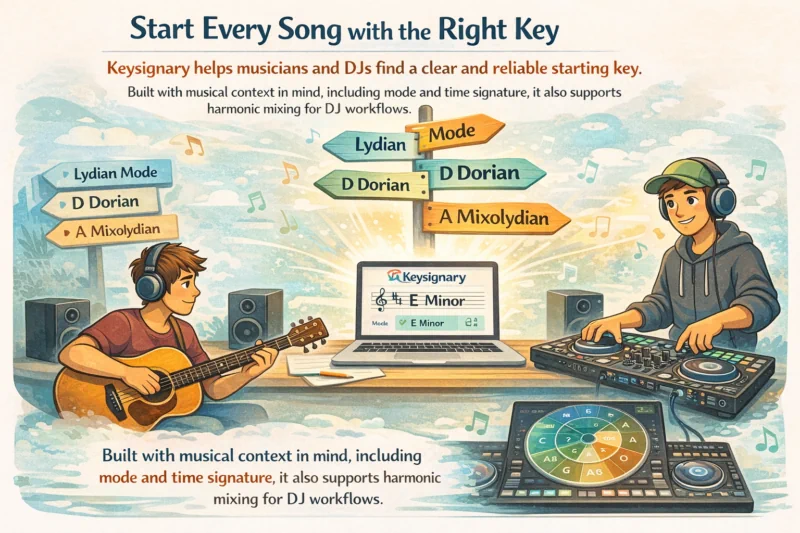
Keysignary helps musicians and DJs find a clear and reliable starting key. Built with musical context in mind, including mode and time signature, it also supports harmonic mixing for DJ workflows.
Our Mission
Keysignary exists to help musicians and students:
- Understand why a song feels centered on a certain key
- Learn modes without confusion
- Avoid technically correct but musically misleading answers
- Develop stronger musical ears, not just memorize labels
Music deserves clarity.
Keysignary is here to provide it.